
The Battle of Sandershausen, 1758
24th July 2025, 0 Comments
The Seven Years War, Honours of War, 28mm
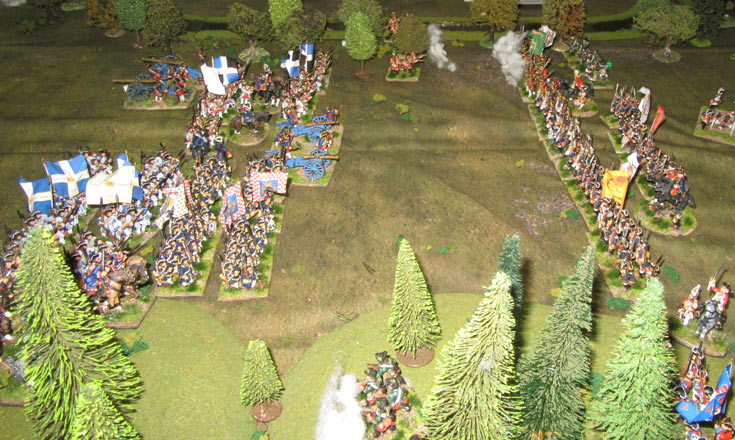
Its been a strange wargaming year, as for various reasons there were several weeks when we couldn’t get a game, as people were away, working or whatever. So, it was great that Sean and I finally got together, for a spot of Seven Years War action. The game was based on the Battle of Sandershausen, fought not far from Kessel and the River Fulda, on 23 July 1758. For this, Sean took my beloved French, and I commanded the Allies.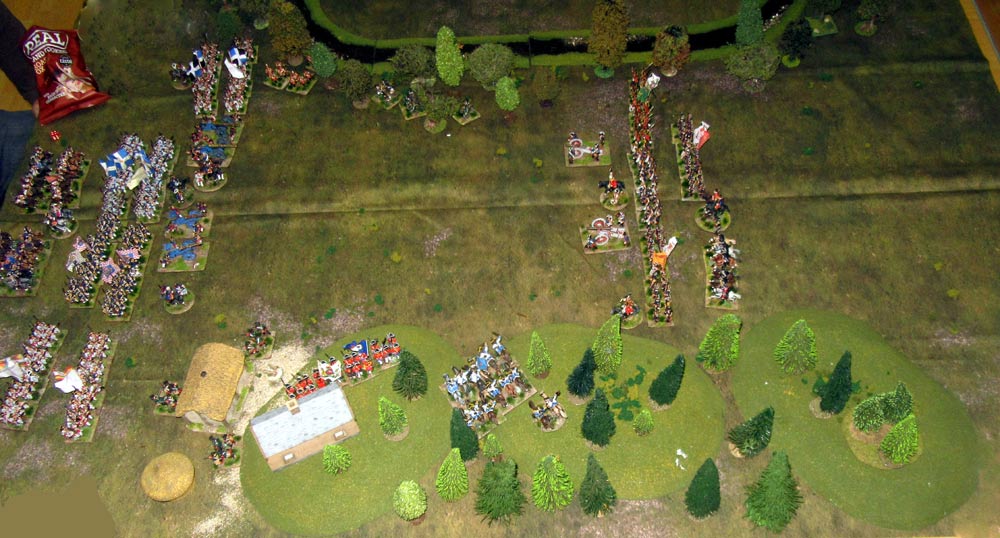 The scenario was largely drawn from my friend Charles Grant’s book Wargaming in History (Vol.1) . The Allies under the Prince Isenburg of Hesse and the French by Victor, Duc de Broglie met in a narrow riverside valley, with the Western Allies on the defensive. Their right flank was secured by the River Fulda, and their left by a steep wooded hill. The Allies had a tiny force of five infantry battalions, two cavalry regiments, some light infantry and a gun battery.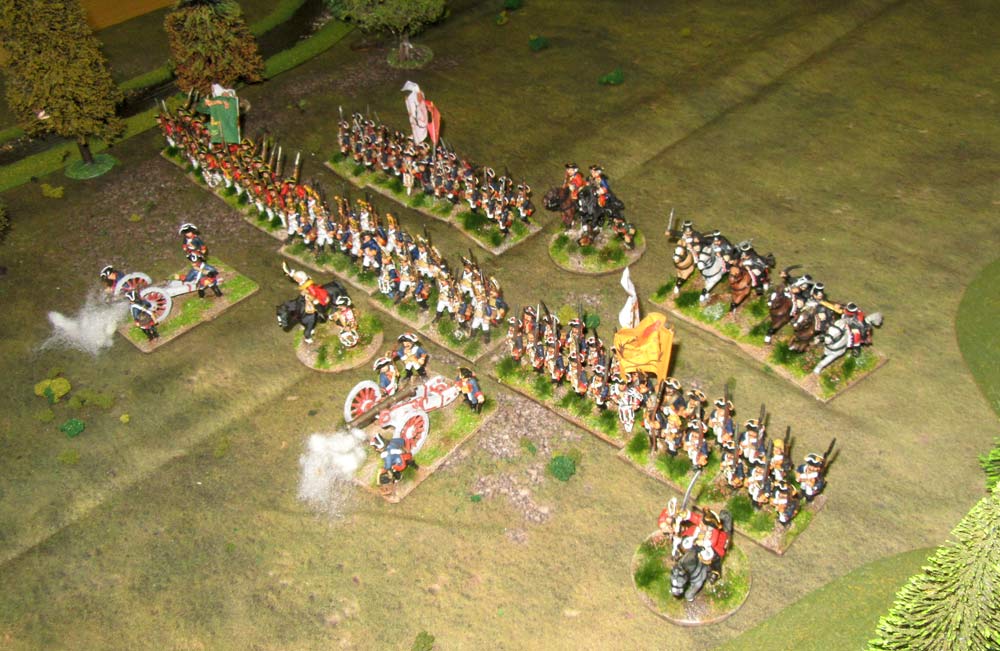
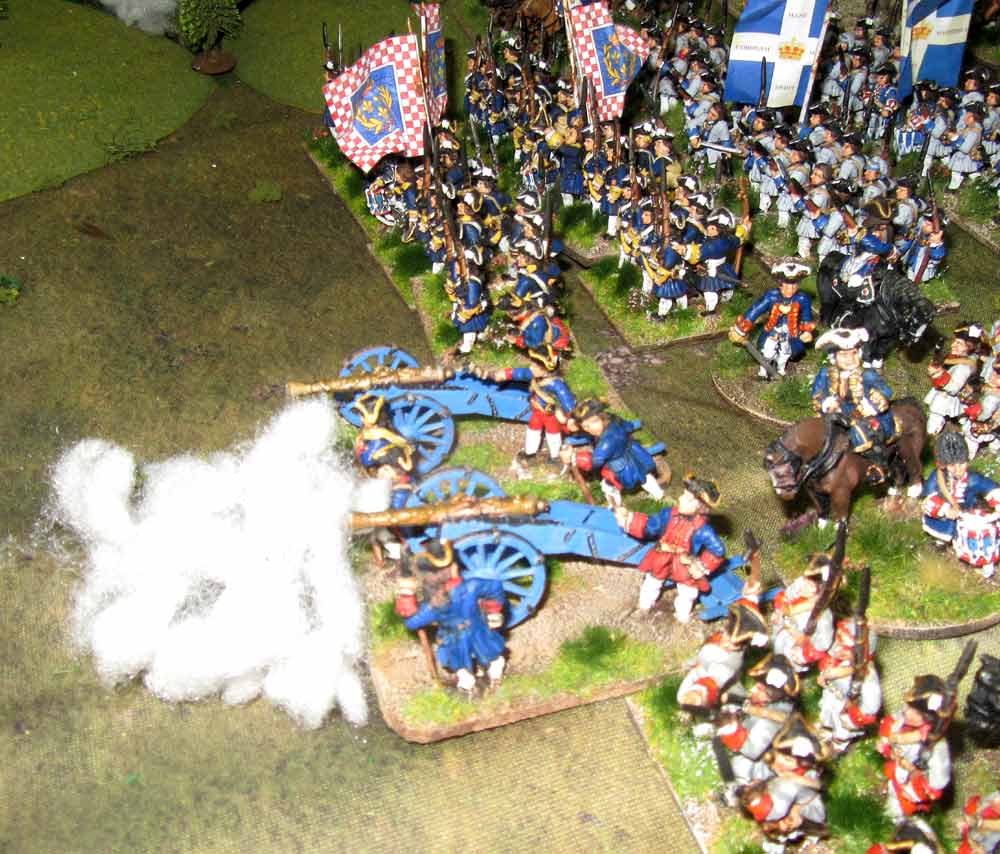
Sean’s French force was much bigger. He had eight battalions, two cavalry regiments, two batteries and a unit of lights. On the Allied left a Hanovarian battalion and a unit of Hanovarian jagers held the small village of Ellenbach, while my other light unit, the Hessian jagers was deployed in the woods by by the river. The French commander had the initiative at the start, and say still, pounding the Allied guns. This lasted for two punishing turns. 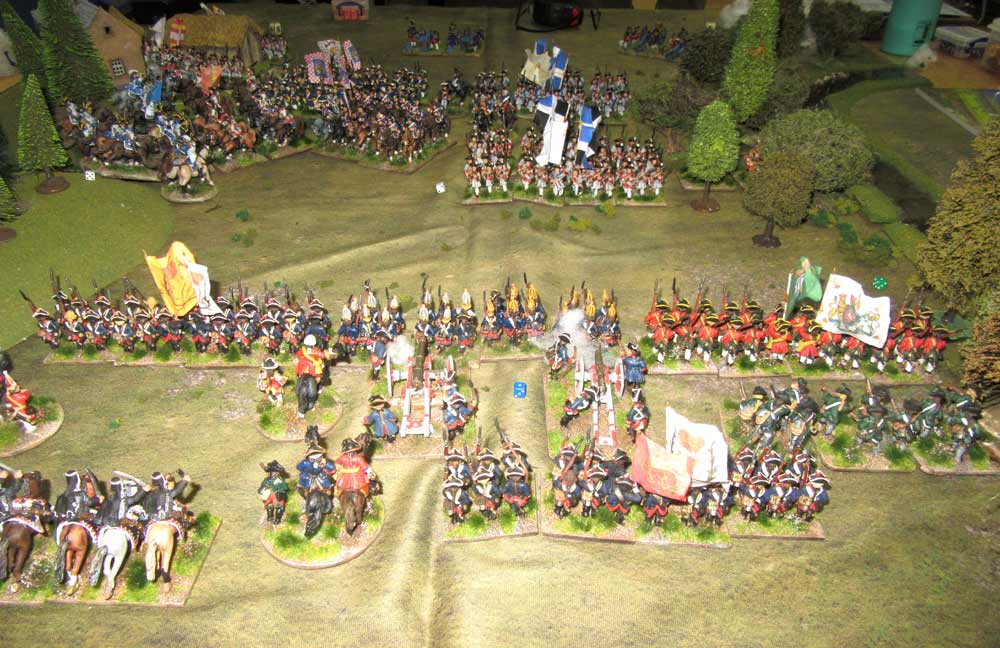 Then the French infantry advanced, and the guns fell silent. My battery though, fired off one round at the German La Marck regiment, then withdrew to the Allied rear, to try to rally off their 3 hits. Five hits and you rout. That meant it was down to musketry to hold the French. The idea of the game was that there were 12 turns until nightfall. The Allies had to hold the pass until then to win the game. I quickly learned that this was going to be a real challenge!
 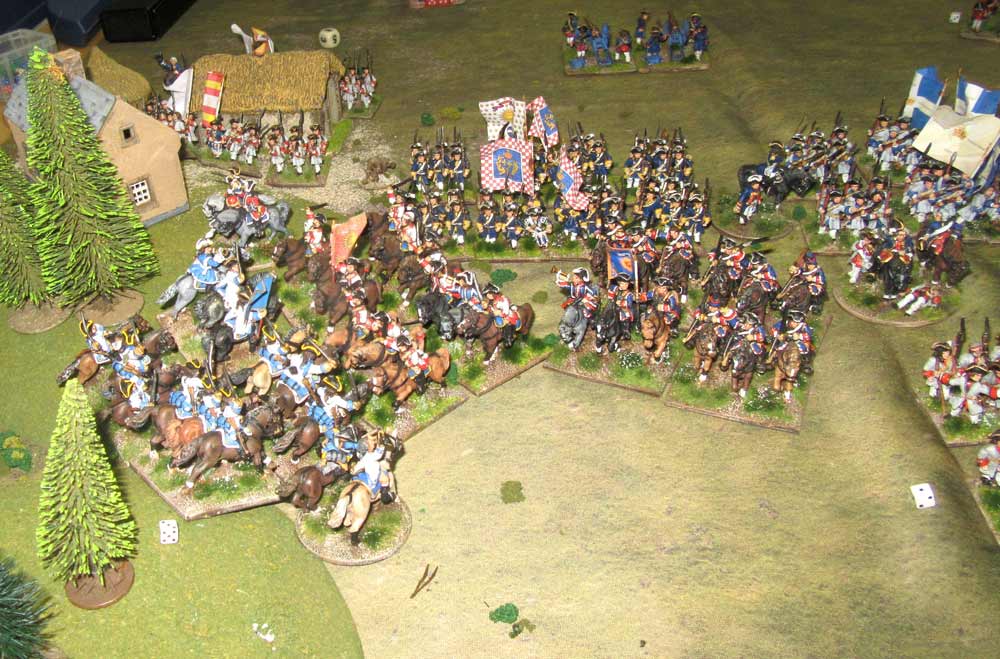 The first clash was on the Allied left, around Ellenbach. The jagers fired away at the two French battalions advancing on the village, then fell back into the nearby woods. The French also suffered hits from the Hanovarian Jung Zastrow battalion, which led to one French battalion retiring. The Hanovarians were getting pounded though, by the French artillery, and so I had to withdraw them into the woods too, away from the guns.
 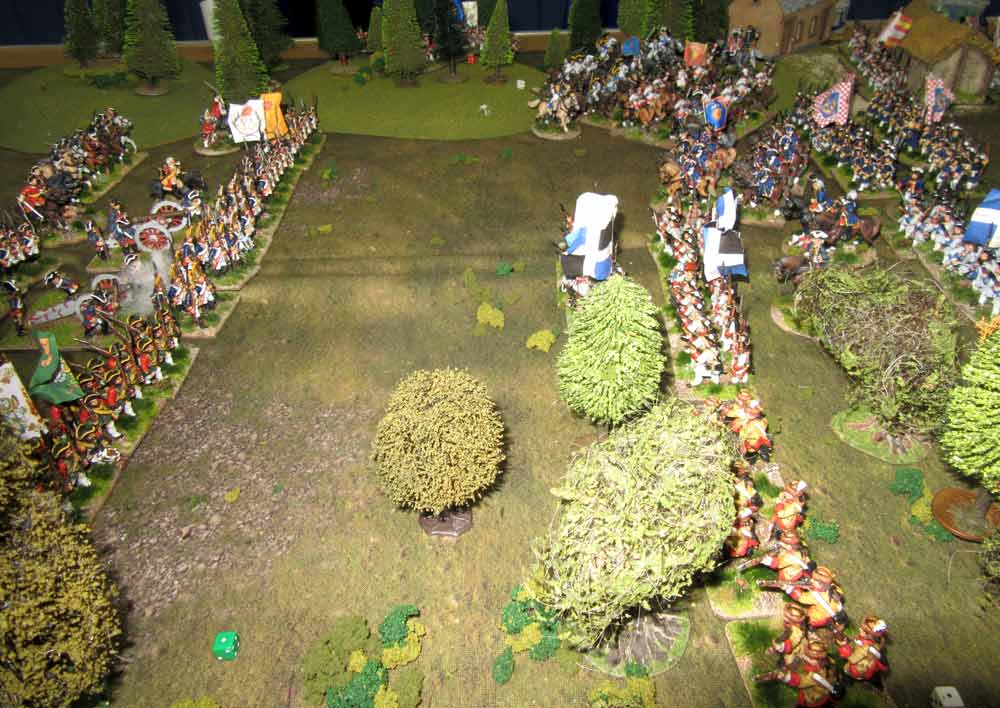 At that point Sean advanced his cavalry, to screen the infantry advance, and I rashly counterattacked from the hill, with the Hessian Liebgarde cavalry hiding in the trees. The French cavalry fought back well, but eventually we both had to retire and lick our wounds. Still, it all bought a little time, and had delayed the main French advance. That was coming though, but for a bit it was delayed by Sean’s now customary streak of poor die rolls!
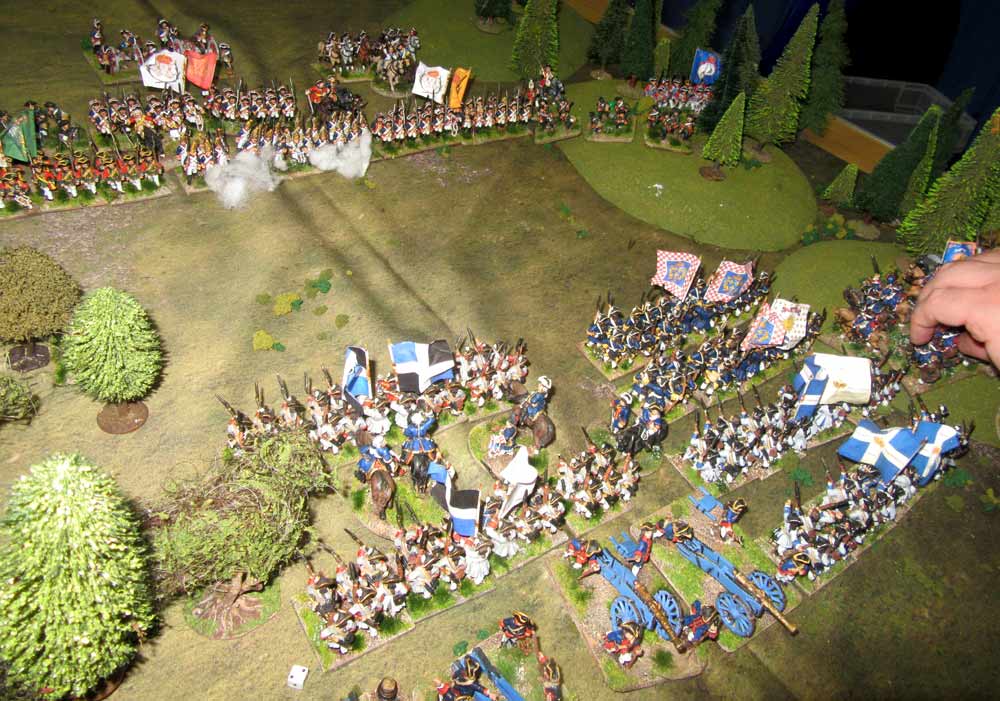 The Hanovarians made good use of this respite, and I busied myself rallying off my ‘hits’ from the guns and the Jung Zastrow infantry. The French cavalry were withdrawn for much the same reason. The clock was ticking though, and I was surprised that the French assault hadn’t begun. What was the French commander up to? Did he have a plan of attack I hadn’t foreseen? What was he up to?
 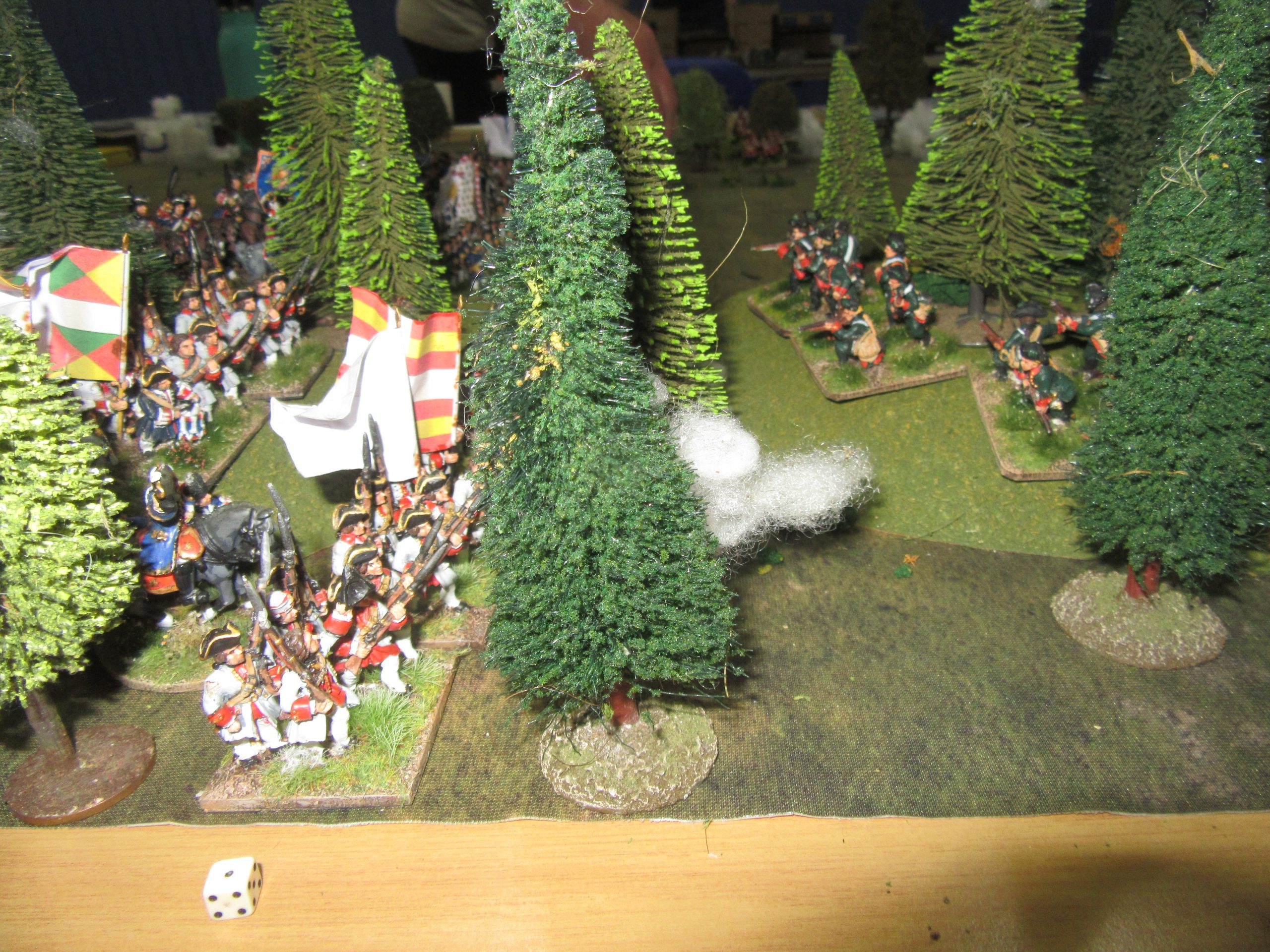 Actually, Sean had some sort of plan, which was to concentrate on the flanks, rather than advance in the open, in the face of the Allied muskets. On the French right the Cambrasis and Tournaisis battalions advanced through the trees beyond Ellenbach, pressing the flank of my thin line. When Jung Zastrow battalion was badly shot up I had to pull them back to recover, leaving my jagers there to hold the line.
  Over on the French left it was a similar story. There, Sean’ slight infantry, the foot of the Volontaires de Clermont-Prince threw back my Hessian jagers, thanks to the support of a battalion of the Lyonnois regiment, and a battery of French guns. On both sides of the table I’d hoped to fire into the enemy flanks when the assault came. Now it looked like the French would be there, firing into my flanks instead!
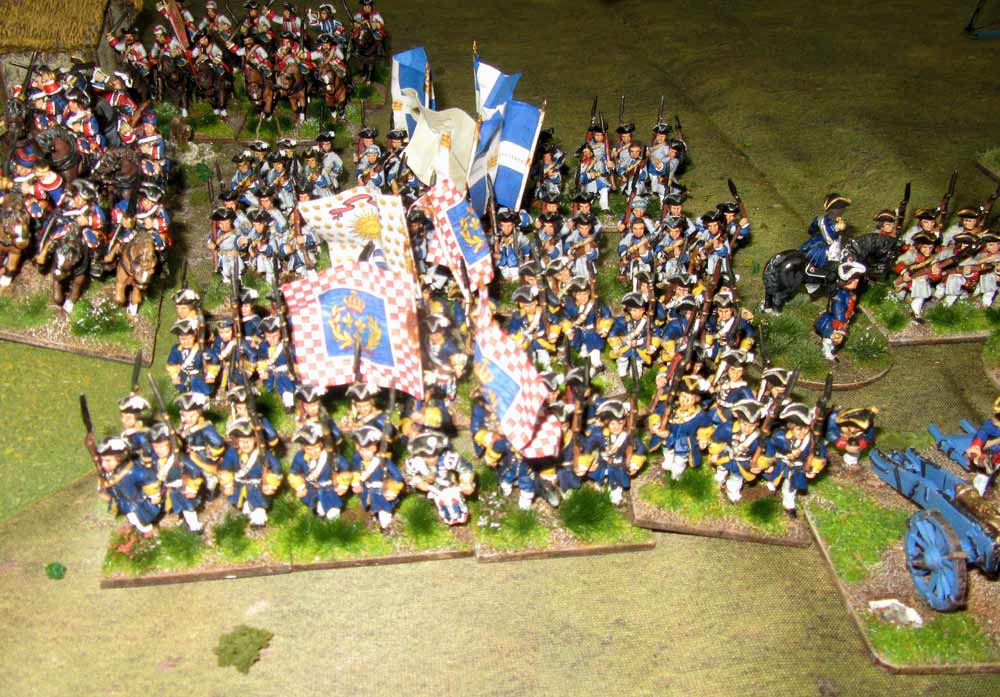
 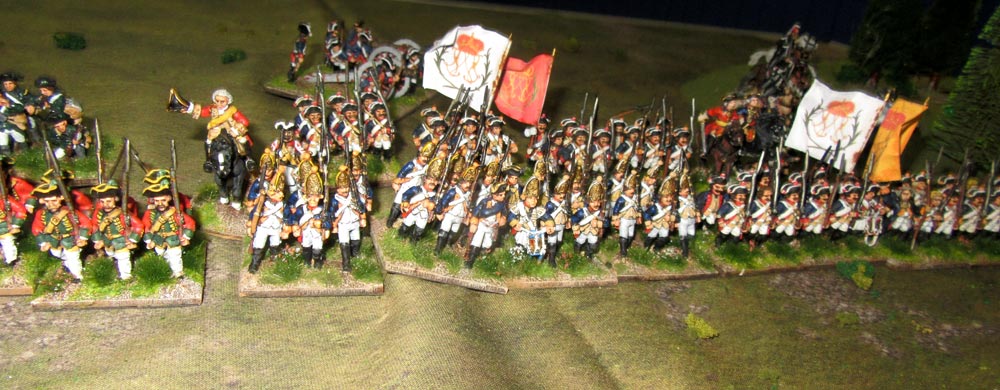 Then the French infantry rolled forward, with the Lyonnoise and La Mark Regiments leading the way. When they came within musket range I opened up all along my thin line. Up above are the Hessian grenadiers, who proved themselves to be pretty good, inflicting enough hits on the leading La Mark regiment to stop them in their tracks, However, La Marine regiment simply just covered their withdrawal as they moved up on their right flank.
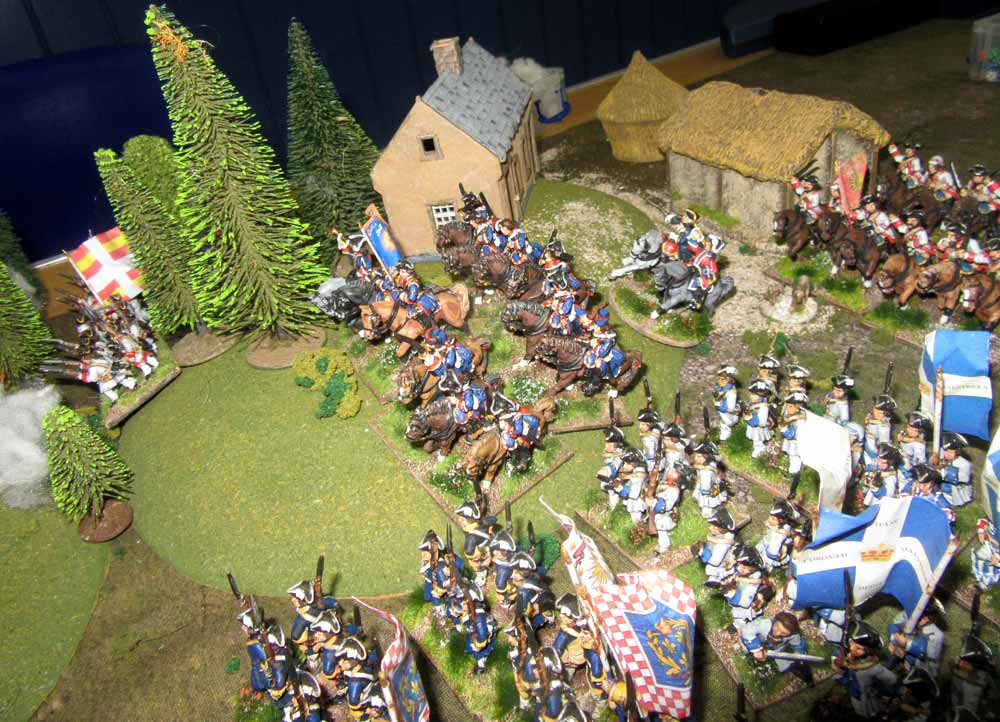 However, it was now Turn 11 and dusk was falling. The French were running out of time. There were masses of French troops, but thanks to the terrain they didn’t have enough room to manoeuvre. In the next turn both sides exchanged musketry, but somewhat battered Allies were declared the victors of this enjoyable but bruising wee defensive battle. It was good fun though, but for once Sean’s usually fearsome tabletop aggression wasn’t in evidence!